AI automation companies in the USA build workflow automation systems, custom AI agents, and intelligent process integrations that replace manual business operations. The 9 companies below cover enterprise data automation, healthcare RCM, SMB workflow engineering, and AI-powered software development, each verified for production delivery.
Which AI Automation Companies Should You Consider in 2027?
The global AI automation market reached $169.46 billion in 2027 and grows at a 31.4% annual rate (HummingAgent 2027 Pricing Survey, 500+ deployments). That growth has saturated the market with providers. Most sell a pitch. Few deliver automation that runs reliably at production scale beyond the first pilot.
Three factors separate high-performing AI automation companies from the rest:
- Process-first approach: they map your workflow before choosing tools, not after.
- Integration depth: they connect automation to your CRM, ERP, or core platforms on day one, not as a later phase.
- Measurable outcomes: they set targets in hours saved, error rate, or cycle time, not in features delivered.
The 9 companies below meet these standards across enterprise, mid-market, and SMB use cases.
Want to see which workflows to automate first?
Book a free 30-minute Stack & Workflow Audit with our engineering team.
Top 9 AI Automation Companies in USA
1. CloudMotiv: Best for AI Workflow Automation and Business Process Optimization
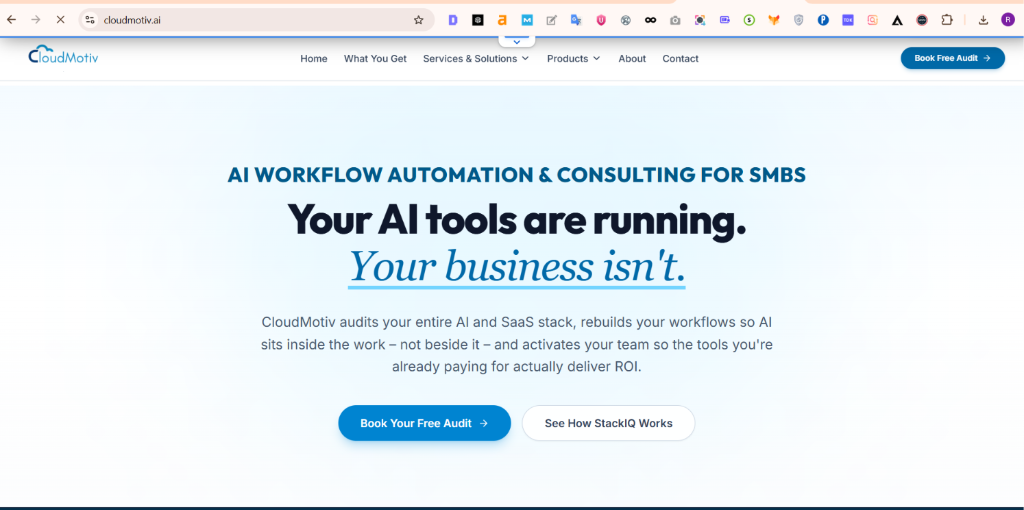
CloudMotiv builds end-to-end AI workflow automation systems that connect fragmented business operations into unified, self-running processes. The company focuses on business process optimization across operations, sales, and customer support, mapping existing workflows first, then deploying automation that integrates with the client's current tech stack.
CloudMotiv works with companies that need production-grade automation, not prototypes. Its implementation approach prioritizes measurable outcomes: reduced manual hours, faster decision cycles, and lower error rates. The team handles workflow design, API integration, LLM orchestration, and post-launch monitoring as a continuous service.
2. BrainBox Automations: Best for Custom AI Agents and Business Automation
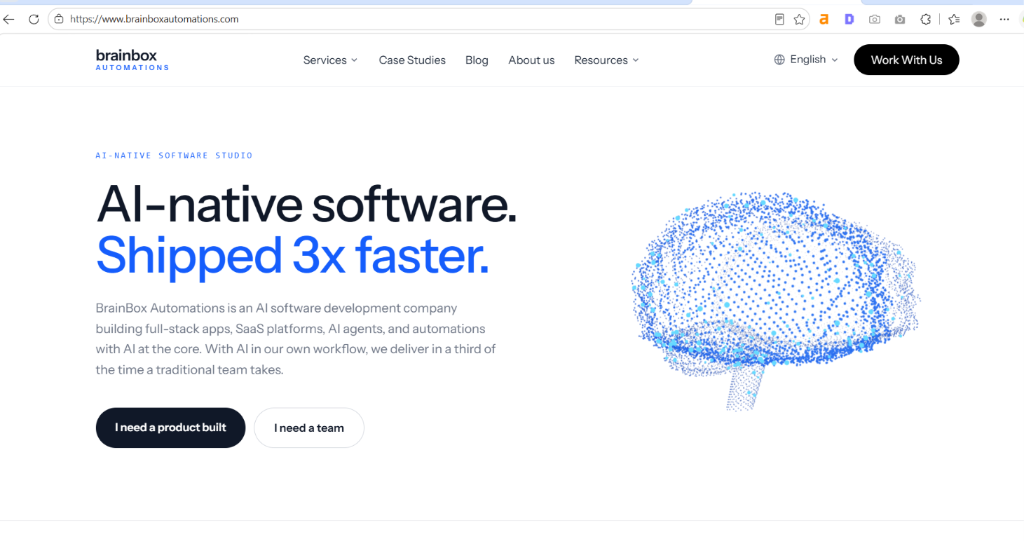
BrainBox Automations builds custom AI agents, conversational chatbots, and multi-step workflow automations that ship in weeks, not quarters. Based in Houston, Texas with a global delivery team, the company serves SMBs and growth-stage businesses that need production-ready automation fast.
BrainBox focuses on three delivery types: AI agents that handle multi-step tasks autonomously, chatbots that qualify leads and handle support, and workflow automation connecting CRM, support tools, and internal systems. Each build includes integration planning and ROI benchmarking before development starts.
3. Binary Brill: Best for AI Workflow Engineering and System Integrations
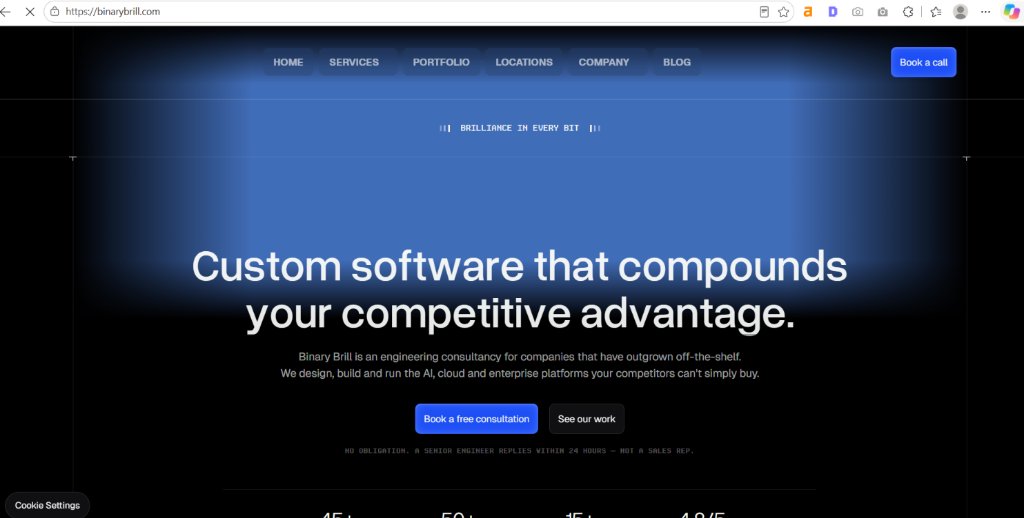
Binary Brill specializes in AI workflow engineering: it connects disconnected systems through custom-built automation that runs across CRM, ERP, and cloud platforms. The company focuses on the technical layer between AI models and business tools: API-based integrations, multi-system data flows, and intelligent process routing.
Binary Brill builds automation for teams that have identified what needs to change but lack the internal capacity to build reliable, scalable connections across their tools. Projects typically involve 3–8 platform integrations per workflow, with ongoing monitoring and maintenance after deployment.
4. Azumo: Best for AI-Powered Custom Software Development
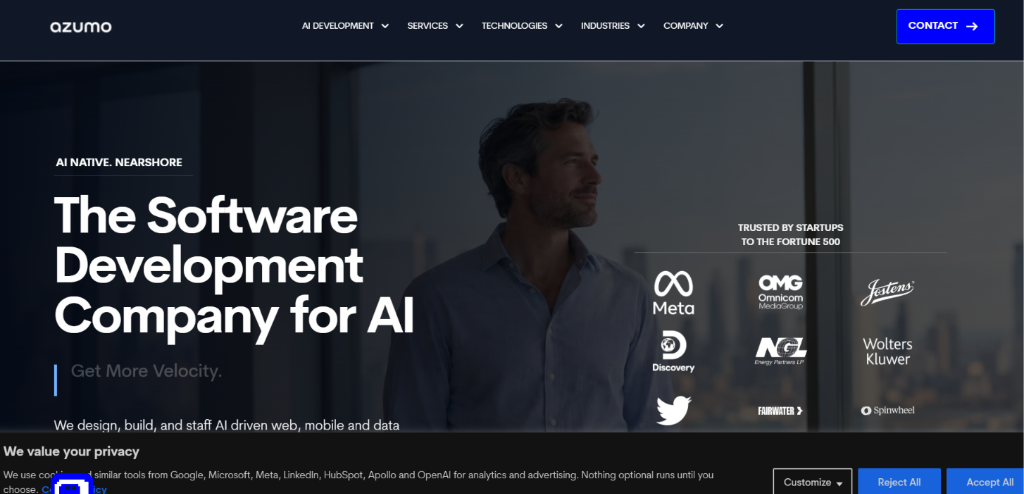
Azumo builds AI-enabled applications with workflow automation embedded from the architecture layer, not bolted onto existing software. Based in San Francisco (founded 2016, 201–500 employees), the company serves businesses that need AI features built into custom internal tools and customer-facing platforms.
Azumo's approach differs from pure automation agencies: it delivers complete software products where AI and automation are core functionality from day one. Projects include AI-driven data pipelines, intelligent recommendation systems, and automated decision-support tools integrated into the client's product.
5. Kanerika: Best for Enterprise AI and RPA Integration
Kanerika is an Austin, Texas-based enterprise technology company (founded 2015, 250–499 employees) that combines AI consulting with its proprietary FLIP platform to deliver production-grade automation across data operations, RPA, and agentic AI workflows. The company holds ISO, SOC, GDPR, and CMMI certifications.
FLIP is Kanerika's low-code/no-code workflow automation accelerator designed for DataOps, data migrations, and enterprise AI agents. In a documented case, Kanerika unified six enterprise systems for a food and pharma client and reduced reporting time from two days to approximately 90 minutes (Microsoft customer story, June 2027). Forbes/Statista, Everest Group, and Intellyx recognized Kanerika in 2025.
Technology stack: FLIP (proprietary), UiPath, Microsoft Power Automate, Microsoft Fabric, Azure AI.
6. EffectiveSoft: Best for Enterprise AI Integration and Custom Solutions
EffectiveSoft is a San Diego-based IT services and software engineering company (founded 2003, 360+ employees) that delivers AI automation as part of enterprise software programs, focused on integration, compliance, and long-term operational stability. The company holds ISO/IEC 27001:2022 certification and appeared in the 2025 Agentic AI in Digital Engineering market report alongside Anthropic, OpenAI, and Accenture.
EffectiveSoft builds governance-first automation: projects include audit logs, human-in-the-loop review points, and security controls from day one. That makes it the right fit for enterprises in healthcare, financial services, and transportation where automation decisions require traceability and regulatory defensibility.
7. ScienceSoft: Best for Custom AI Development and IT Implementation
ScienceSoft is a McKinney, Texas-based IT consulting and software development company founded in 1989, with 36 years of AI experience and 750+ IT experts on staff. The company builds custom AI solutions across traditional ML, generative AI, and agentic AI, covering healthcare, financial services, manufacturing, retail, and telecom.
ScienceSoft began as an AI product company and created a system now used by 40% of Fortune 500 companies in computer-aided engineering. The Financial Times named it among The Americas' Fastest-Growing Companies for the second consecutive year. IAOP recognized ScienceSoft among the Global Outsourcing 100 for the fifth straight year in 2027, alongside Deloitte, EY, and KPMG.
Pricing: Clutch projects $8,000 to $1M+; $50–$99/hr avg rate.
8. 2V Automation: Best for Business Process Automation and n8n Workflows
2V Automation is a New York-based, certified n8n Expert Partner that designs and builds production-grade automation systems for growing companies, replacing fragile, one-off workflows with scalable infrastructure built on n8n, custom code, and AI integrations. The company operates across New York, Germany, Canada, Australia, and the United Kingdom and holds a Clutch Champion and Global Award designation.
2V Automation targets SMB to mid-market clients who want automation systems they own and can extend internally. Projects range from $5,000 to $100,000+. A documented client result: a monitoring, task assignment, and reporting workflow that previously consumed manual hours now runs fully automatically with Slack integration, reducing team overhead within the first 30 days.
Pricing: Projects from $5,000; unlimited plan at $3,890/month.
9. Flobotics: Best for AI Agents and Healthcare Process Automation
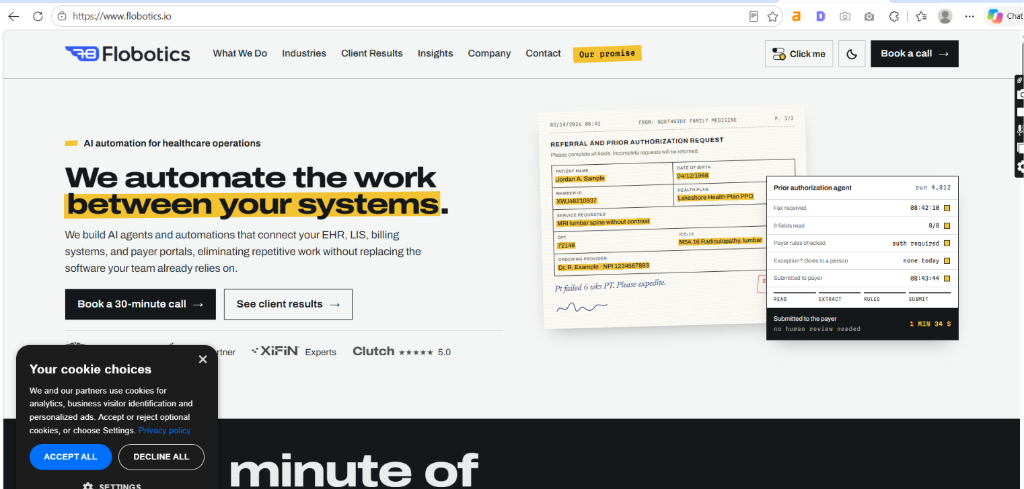
Flobotics is a healthcare-focused AI automation company that specializes in revenue cycle management (RCM) automation for U.S. healthcare providers, handling the administrative load of billing, claims, eligibility, and A/R follow-up so clinical staff can focus on care. The company combines RPA, UiPath, and AI agent frameworks purpose-built for the complexity of U.S. healthcare billing.
Flobotics uses agentic AI with contextual memory (Agentic RAG) and Model Context Protocol (MCP) to connect directly with EHR systems (Epic, Cerner), clearinghouses, and payer portals. This eliminates the screen-scraping fragility of traditional RPA. Classic bots stop on claim exceptions. Flobotics' agents retrieve missing data, investigate payer portals, and resolve the exception autonomously. The company holds a 5.0 rating across Quality, Schedule, and Cost on Clutch.
Technology stack: UiPath, AI agent frameworks, Agentic RAG, MCP, EHR integrations (Epic, Cerner).
How Do You Choose the Right AI Automation Company?
The right AI automation company depends on your process complexity, the number of systems involved, and your industry's compliance requirements. The 6 criteria below cut through the noise.
1. Identify the Business Processes You Want to Automate
Start with a specific workflow, not a broad mandate to automate everything. Document which steps are manual, which systems are involved, and how much time the process consumes per week. Companies that begin with a single high-volume process (invoice processing, lead qualification, support triage) recover their investment 2–3x faster than those starting with an open-ended transformation mandate.
2. Check AI Workflow Automation and Integration Expertise
A strong provider maps how automation connects to your existing CRM, ERP, and internal tools before writing a line of code. Ask for the integration plan in writing: which APIs it uses, how data flows between systems, and how exceptions are handled. Generic answers here indicate the provider is selling tooling rather than solving your specific workflow problem.
3. Evaluate Custom AI Agent Development Capabilities
AI agents operate differently from rule-based RPA. Ask whether the company builds agents on frameworks like LangChain, LangGraph, or CrewAI — or whether they wrap a third-party chatbot and call it an agent. Production-grade agents maintain state across multi-step tasks, handle edge cases, and integrate with your data sources. Demos in controlled environments tell you nothing about performance under real-world conditions.
4. Review Client Case Studies and Production Results
A portfolio of demos means nothing. Ask for a specific result from a completed project: how many hours did the client save, what error rate did it address, and how long did the system run before its first failure. Companies with real production results cite specific numbers. Those without cite capabilities.
5. Check Data Security and AI Governance
For projects touching customer data, financial records, or healthcare information, verify certifications: ISO/IEC 27001, SOC 2 Type II, HIPAA compliance (healthcare), and GDPR compliance (European data). Ask how the automation logs decisions, who can audit AI outputs, and what the rollback procedure is when a workflow makes an incorrect decision. EffectiveSoft and Kanerika are the two companies on this list with published, verifiable certifications across these standards.
6. Compare Implementation and Ongoing Support
The most expensive automation mistake is a system that works in demo but breaks in production six weeks later when an API changes. Ask what the ongoing support model covers: API updates, model retraining, monitoring alerts, and iterative workflow improvements. Month-to-month retainers are safer than annual commitments until you've seen a live system perform at scale.
How Much Does It Cost to Hire an AI Automation Company in the USA?
AI automation costs in the USA range from $5,000 for a focused single-workflow implementation to $500,000+ for enterprise-scale multi-system programs. The ranges below are compiled from Clutch-verified project data, published agency pricing pages, and the 2027 HummingAgent Pricing Survey (500+ deployments).
AI Automation Consulting Costs
An initial AI consulting engagement (process audit, automation readiness assessment, and roadmap) costs $5,000–$25,000 for small businesses and $25,000–$75,000 for enterprise programs. Hourly consulting rates from specialized AI automation firms in the USA range from $150–$300/hour for mid-tier agencies. Large enterprise consulting firms charge $350+/hour. Most established agencies price discovery as a fixed project, then apply it toward implementation if you proceed.
Custom AI Agent Development Costs
Custom AI agent development (building agents that perform multi-step tasks, integrate with existing systems, and maintain contextual memory) costs $15,000–$150,000+ depending on agent complexity, the number of integrated systems, and governance requirements. A single-purpose agent (lead qualification or support triage) typically costs $15,000–$40,000. Multi-agent systems with enterprise integrations run $75,000–$150,000+. ScienceSoft's Clutch-verified project history and Kanerika's enterprise engagement data confirm the upper range for large-scale builds.
AI Workflow Automation Implementation Costs
Workflow automation connecting 2–4 systems (CRM + email + data layer) costs $5,000–$30,000 for SMBs and $30,000–$150,000 for enterprise programs with security reviews, compliance controls, and cross-department scope. 2V Automation's project range ($5,000–$100,000+) represents the SMB-to-mid-market spectrum. Published project data from enterprise-focused firms confirms the $80,000–$300,000 range for mid-market implementations (Viitorcloud 2027 AI Implementation Cost Analysis).
Ongoing Maintenance and Support Costs
Monthly retainers for AI automation maintenance (monitoring, API updates, model retraining, and iterative workflow improvements) range from $1,000–$5,000/month for SMBs and $5,000–$20,000/month for enterprise programs. 2V Automation's unlimited plan is $3,890/month. Without a maintenance retainer, integrations break silently as APIs change and AI models drift. The first production failure typically costs more to fix than 3–6 months of retainer fees.
For a complete cost breakdown by agency tier and retainer structure, read our comprehensive guide on AI automation agency pricing in 2027.
What Business Processes Can AI Automation Companies Automate?
AI automation companies automate any process that is high-volume, rule-driven, or decision-based with consistent inputs. The examples below are verified use cases across the companies listed in this guide.
Sales and Lead Generation Automation
AI SDR automation captures leads from forms, social media, and inbound email, enriches contact data through tools like Clay or Apollo, scores leads using LLM-based qualification logic, and routes qualified contacts to the correct sales rep in the CRM within seconds. Companies using AI-driven lead qualification report 30–40% reduction in time-to-first-contact. Full AI SDR sequences run outbound outreach, follow-up, and meeting booking with minimal human input, cutting SDR overhead per pipeline stage by 50–70%. Explore how our Outbound AI SDR and Inbound AI SDR operate.
Marketing Workflow Automation
Marketing automation handles content scheduling, campaign creation from brief to draft, A/B testing logistics, performance report generation, and CRM-to-ad-platform data sync. BrainBox Automations documented a creative team that reduced content batch production from 5 days to under 24 hours using AI workflow automation with the same 3-person team. AI agents draft, review, and schedule across 5+ platforms from a single trigger.
Customer Support Automation
AI customer support automation handles ticket triage, intent classification, FAQ resolution, escalation routing, and customer notification. AI-powered support agents resolve 60–80% of Tier 1 support requests without human involvement: password resets, order status updates, billing questions, and product FAQs. Escalation logic routes complex cases to human agents with full conversation context attached.
Finance and Accounting Automation
Finance automation addresses accounts payable, invoice processing, expense report categorization, bank reconciliation, and financial close workflows. Kanerika's accounts payable automation for a U.S. fuel distribution company reduced invoice processing time by over 70% and eliminated manual data entry errors. Document AI extracts structured data from PDFs and unstructured invoices with 95%+ accuracy using optical character recognition and LLM-based field extraction. Read our guide on how to eliminate manual data entry across business processes.
HR and Recruitment Automation
HR automation handles candidate sourcing, resume screening, interview scheduling, onboarding document collection, and employee record updates. Kanerika built an RPA-driven recruitment process that automated CV parsing, scoring, and calendar-based interview scheduling, reducing recruiter time per hire by 60%. AI-driven onboarding systems send documents, collect e-signatures, and update HR platforms without manual intervention.
Operations and Business Process Automation
Operations automation connects supply chain data, inventory systems, logistics platforms, and reporting dashboards into unified, real-time workflows. 2V Automation built a monitoring, task assignment, and reporting system where everything that previously required manual checks now triggers and executes automatically. Business process automation at scale typically reduces manual operational overhead by 20–40% within the first 6 months. Review our RevOps workflow automation services.
IT and Technical Support Automation
IT automation handles ticket creation, categorization, resolution routing, and status updates. AI-driven IT support agents resolve Tier 1 and Tier 2 requests (password resets, software provisioning, access requests) without human involvement. Monitoring automation detects anomalies, triggers alerts, and can initiate remediation workflows before the IT team is paged, cutting mean time to resolution (MTTR) by 40–60% in documented enterprise deployments.
Frequently Asked Questions
Which AI Automation Company Is Right for Your Business?
Start with the process, not the partner. Identify one workflow consuming 10+ hours per week in manual work, document the systems it touches, and use that as your brief.
- Enterprises with governance requirements: EffectiveSoft (ISO/IEC 27001) and Kanerika (FLIP platform, certified across AWS, Azure, Microsoft Fabric) are the strongest fits.
- Healthcare and RCM teams: Flobotics is the only company on this list purpose-built for U.S. healthcare RCM automation, with agentic AI connected directly to EHR systems.
- SMBs needing fast deployment: BrainBox Automations (2–4 week delivery) and 2V Automation (certified n8n partner, projects from $5,000) serve this segment reliably.
- Companies embedding AI into custom software: Azumo and ScienceSoft build production-grade AI-enabled applications with 10+ and 36+ years of engineering depth respectively.
- End-to-end workflow and operations automation: CloudMotiv covers the full implementation and optimization cycle: from process mapping through agentic AI deployment and ongoing monitoring.
Request a scoped proposal, ask for one live reference call with a current client, and start with a single workflow. The first automation that proves measurable ROI gives you the clearest basis to expand.

Akshay Pol
Akshay Pol is Co-Founder & CEO of CloudMotiv and Principal AI Solutions Architect. He designs and implements production AI workflow automation systems, autonomous SDR agents, and data integration infrastructure for growing American companies.
Book a Free 30-Minute Stack & Workflow Audit
We review your software tools, identify manual bottlenecks, and map out a fixed-cost automation plan tailored to your business.