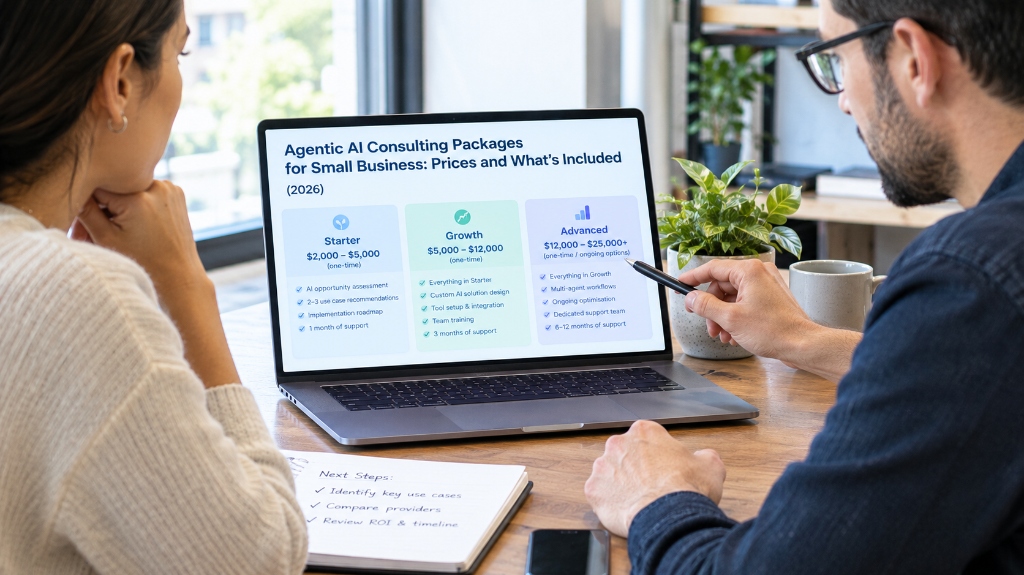
Agentic AI Consulting Packages for Small Business: Prices and What's Included (2026)
What an agentic AI package includes, what it costs in 2026, and how to check scope, guardrails and payback before you sign.
Quick Answer
An agentic AI package for a small business typically costs $2,500 to $10,000 to put one AI agent on one workflow, plus $20 to $50 per user per month in software and usage-based model fees. Ongoing retainers run about $1,500 to $8,000 a month. Check that the package includes guardrails, human approval steps, a test set and a named owner after handover.
An agentic AI package for a small business is a fixed set of work that gets an AI agent running one real workflow, with limits on what it can do. An agent differs from a chatbot or a simple automation: it takes several steps on its own, uses tools like your CRM or inbox, and chooses its next step based on what it finds.
What do the packages cost, and when are they done?
| Package | Best for | What's included | Done when | Published price |
|---|---|---|---|---|
| Readiness audit | You want agents but don't know where | Workflow map, ranked use cases, costed first build | You have one named workflow and a price for it | $2,000–$8,000 |
| Single-agent pilot | One clear, repeating workflow | One agent, tool connections, approval steps, test set, staff training, written handover | The agent passes the test set and the baseline metric moves | $2,500–$10,000; multi-system builds cost more |
| Retainer or fractional AI lead | Several workflows queued, a team to act between calls | Roadmap, monitoring, fixes, quarterly review | Each workflow has an owner and a target number | $1,500–$8,000 a month |
Pilots usually take 2 to 12 weeks, depending on how many systems they connect. Ranges come from published market data.
How much do agentic AI consulting services cost for a small business?
The consultant's fee is only part of the bill. Add these:
Three things move a quote: how many systems the agent touches, how sensitive the data is, and how much human review you want.
Work out payback before you sign: Months to payback = first-year total cost ÷ monthly saving Example: Invoice entry takes 60 hours a month at $35 an hour ($2,100/mo). An agent removes about two-thirds, saving $1,400 a month. A $12,000 build plus software and staff time gives a first-year cost near $15,200. Payback is under 11 months. At 15 hours a month, the same build takes over three years, which is a strong case for waiting.
Do you need an agent, or would a simple automation do?
If the steps never change, use a plain automation in Zapier, Make or n8n. It is cheaper and easier to fix.
Choose an agent when the input varies, the task has several steps and a person currently makes small judgment calls. Examples are sorting mixed customer emails, or matching invoices to purchase orders and flagging mismatches.
Be sceptical of the label. Gartner has predicted that over 40% of agentic AI projects will be cancelled by the end of 2027, and it has warned that many products sold as agentic are rebadged chatbots or RPA. Ask any vendor to show the agent choosing between steps.
What should be in the package so the agent doesn't create new problems?
Ask for each item in writing:
The NIST AI Risk Management Framework is a free reference. A consultant who works to it will have specific answers.
How do you spot a weak package before you sign?
Watch the first call. A good consultant asks how your work flows before naming a product. A weak one names a single platform in the first ten minutes.
Ask: what number should move in 90 days, and what happens to the fee if it doesn't?
Frequently Asked Questions
Q:What's a good first workflow for an agent?
Q:Can I do this without a consultant?
Q:Is a retainer worth it?
Your next step
Pick one workflow that takes more than 20 hours a month. Write down how long it takes today and how often it goes wrong. Run the payback calculation above, then bring that page to a scoping call.
Ready to scope your first agentic workflow? Book a 30-minute workflow scoping call with CloudMotiv today.
Related Reading
AI Consultant Hourly Rate for Small Business 2026: What You'll Actually Pay
Most small businesses pay $150–$350 an hour for an independent AI consultant. See rates by who you hire, what the hours add up to, and how to check a quote.
AI Consulting for Small Businesses 2026 Trends: Demand, Cost and What to Do First
66% of small businesses use AI, but 70% say they need more training. See the 2026 trends driving demand for outside help, what it costs, and when to wait.
Best AI Readiness Consulting Services for Small Businesses in USA (2026 Guide)
What AI readiness consulting costs in USA, what you should receive, and which option fits a business with no IT team. Prices checked October 2026.