Why Enterprises Struggle to Scale AI Consulting Services (and What Fixes It)
Only 5% of companies get AI value at scale. See the 5 reasons pilots stall, a 7-check scale gate and a 12-week plan to reach production.
Quick Answer
Enterprises struggle to scale AI because pilots run in isolated environments with relaxed security and static data. Scaling requires unified data pipelines, named operational owners, enforceable governance, and measurable user adoption. Fix it by baselining one KPI, building a thin production slice within 8 weeks, and passing a seven-check scale gate before rolling out across departments.
Written by Akshay Pol, Principal AI Solutions Architect · Last updated: October 2026
Your pilot worked. The demo impressed executive leadership, the sponsor approved the budget, and yet twelve months later it remains stuck in one department, used by a handful of people.
You are in large company: BCG's study found that only 5% of companies achieve AI value at scale, while 60% report minimal gains despite heavy investment. The cause is rarely the core model—and it is fixable.
What does "struggling to scale" look like inside an enterprise?
Before troubleshooting architecture, identify the operational symptoms of stalled scale:
According to CGI's research, 49% of organizations cannot quantify tangible results from their current AI implementations.
Why do AI pilots stall before they reach production?
1. The value was never defined against a business baseline
Teams frequently start with technology use cases rather than business outcomes. When success criteria aren't pegged to cycle time, labor hours, or error rates, teams report deployment milestones instead of financial return.
2. Pilot conditions do not exist in production
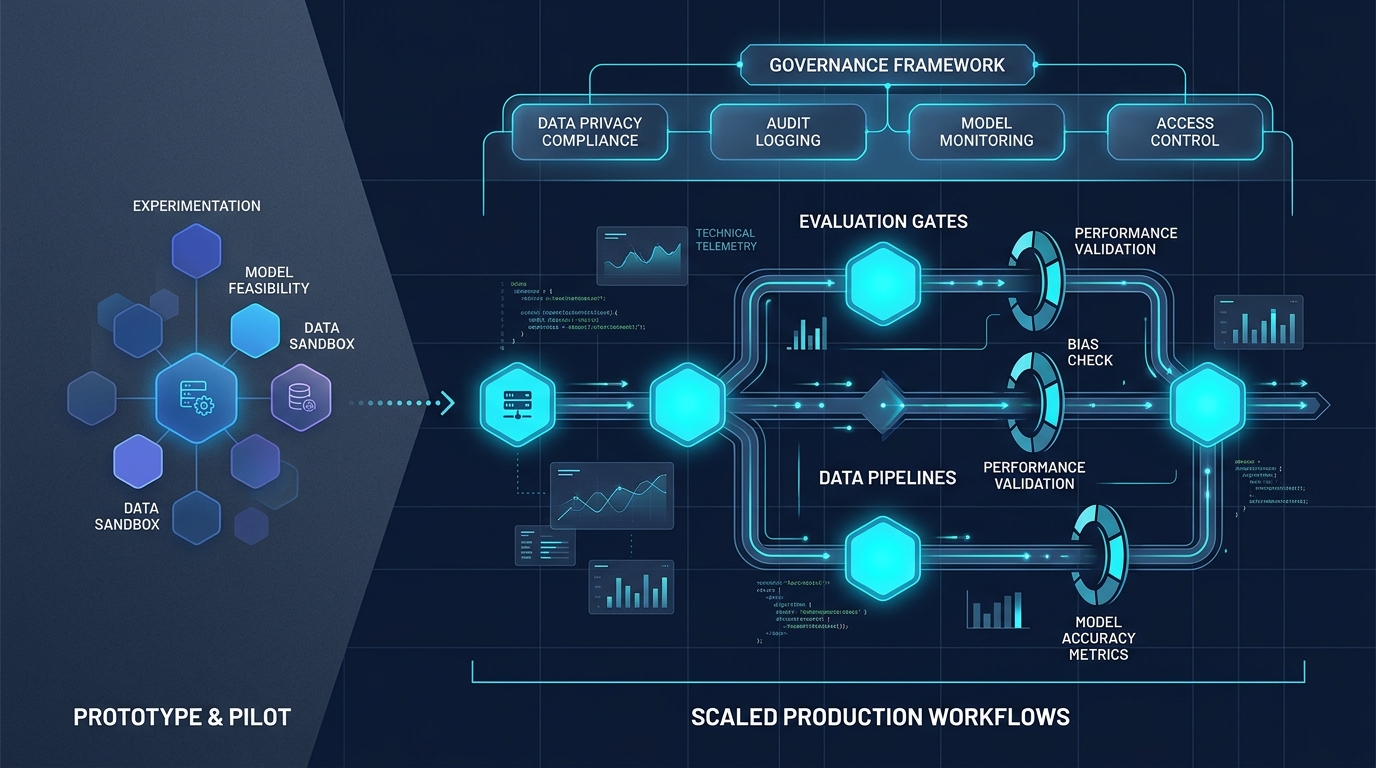
Controlled proofs-of-concept relax compliance, data pipelines, and systems integration to meet a demo deadline. Production requires consistent data streams from multiple core systems, explainability, latency SLAs, monitoring, and automated fallbacks. That is production systems engineering, not standalone data science.
3. Most enterprises work in "edit mode"
AI exhibits rapid, flashy wins on greenfield code or drafting net-new text. However, enterprise value lies in modifying, reconciling, and validating decades-old workflows, unstructured legacy records, and multi-system databases. Improving these entrenched operational workflows is significantly harder to predict and prove without deep systems integration.
4. People and process receive the least attention
BCG found that roughly 70% of enterprise AI transformation challenges are people and process, yet algorithms and model testing absorb a disproportionate share of project time. When front-line teams aren't trained or incentivized to change their daily habits, adoption dissolves once the pilot team exits.
5. Governance arrives as an afterthought
When security, privacy, and compliance reviews are bolted on at the final stage of development, the inevitable audit flags force complete architectural redesigns right when leadership expects to expand.
Could your consulting engagement be the reason it won't scale?
External consulting partners often inadvertently engineer systems that work in presentations but stall in daily operations. Check your engagement for these six critical warning signs:
Industry analysts at Ness note that conventional firms frequently stop at high-level strategy and hand execution back to the client, leading enterprises to increasingly seek end-to-end partners who deliver both strategy and live system implementation. The antidote is writing enforceable scale criteria directly into the statement of work.
What does practical consulting look like when scale is the goal?
A production-oriented engagement replaces multi-month strategy decks with a focused 12-week delivery framework designed around a hardened, thin production slice:
| Phase | Timeline | Core Objective | Checkable Deliverables |
|---|---|---|---|
| Phase 1: Baseline & Selection | Weeks 1–2 | Measure current baseline KPIs. Select 1–2 high-impact workflows with accessible data and a named business owner. | Documented KPI baseline, verified data access, named business and technical owners. |
| Phase 2: Thin Production Slice | Weeks 3–8 | Build one end-to-end workflow inside real enterprise systems, equipped with automated evals, guardrails, telemetry, and human review. | Live software service with a small user cohort; real-time operational dashboard. |
| Phase 3: Scale Gate & Handoff | Weeks 9–12 | Test against the 7-check scale gate, write operational runbooks, and train internal engineers on maintenance. | Formal go/no-go audit, complete runbook, shared modular components for rapid expansion. |
At CloudMotiv, our AI Implementation Consulting methodology uses this exact three-phase lifecycle to prevent pilot purgatory and ensure internal teams maintain total software ownership.
The scale gate: seven checks before you expand
Before committing additional capital to roll out an AI solution across other business units, require the pilot to pass this rigorous seven-point scale gate:
When should you hire an AI consultant vs build in-house?
Evaluate your organizational position based on what resource is scarcest: time, technical domain skills, or proprietary control.
| Your Situation | Recommended Direction | Strategic Rationale |
|---|---|---|
| AI is core to your primary product or IP | Build in-house | Retain direct IP ownership and algorithms; engage specialized consultants only for targeted technical bottlenecks. |
| You need an operational production workflow within a quarter | Hire an operational consultant | Rapidly deploy working infrastructure without months of hiring friction; mandate code handoff in the contract. |
| You have data engineers, but no MLOps or governance practice | Hybrid model | Internal engineers build data models; external consultants architect deployment pipelines, observability, and guardrails. |
| You handle regulated data with no existing governance template | Consultant setup → Internal ownership | Hire specialists to establish compliant frameworks (NIST, HIPAA, SOC 2), then retain long-term internal operational custody. |
| You plan enterprise rollouts across several business units | Build internal CoE with coaching | Establish a core AI Center of Excellence paired with targeted fractional advisory to maintain velocity. |
Regardless of the path chosen, require comprehensive knowledge transfer so technical capability remains inside your enterprise long after the contract concludes.
What does a scaled engagement achieve? A real production example
To understand how a scale-first methodology operates in practice, consider our production deployment with a high-growth US cloud infrastructure and B2B SaaS platform (140+ employees):
Enterprise Cloud Operations & Incident Triage
The Challenge: Disparate monitoring tools and disconnected incident bots caused severe alert fatigue, slowing critical escalation triage and draining valuable support engineering hours.
The Operational Fix: CloudMotiv audited the toolchain, decommissioned three redundant bot subscriptions, and engineered a consolidated triage pipeline directly within Slack—integrating Jira Service Management, Supabase, and PagerDuty APIs with automated vector embeddings for real-time ticket categorization.
Key Production Outcomes:
• $185,000 in annual SaaS spend eliminated.
• 75% faster escalation triage on critical production incidents.
• 30 days from initial stack audit to live enterprise deployment.
Read the full details in our verified Cloud Operations Triage Case Study.
How do you measure productivity and efficiency gains?
Set baseline measurements before starting implementation. Then evaluate the workflow across three connected operational vectors:
Crucially, track Weekly Active Users (WAU). An AI capability that achieves high benchmark accuracy but lacks user adoption produces zero financial return. Furthermore, expect net-new creation tasks (drafting, summarization) to show productivity gains much earlier than complex edit-mode reconciliation workflows, and set performance targets accordingly.
Frequently Asked Questions
Q:Why do most enterprise AI pilots fail to reach scale?
Q:What is the NIST AI Risk Management Framework (RMF)?
Q:How can enterprise leaders verify an AI consultant delivers production code?
Q:What is a realistic timeline for an enterprise AI rollout?
How Cloudmotiv scales enterprise AI
CloudMotiv is an AI operations consulting and intelligent automation firm that bridges the gap between pilot experiments and durable production systems. Through our AI consulting practice, we specialize in operational architecture, automated workflow engineering, governance guardrails, and complete client handoffs across enterprise infrastructure.
Next step: Schedule a Scale-Readiness Review. Bring one stalled pilot or upcoming enterprise initiative to an objective evaluation session. You leave with a scored diagnostic against the 7-Check Scale Gate and an actionable blueprint of the first two technical fixes required to reach production scale.

Co-Founder & CEO · CloudMotiv
Akshay brings 10+ years of tech consulting and systems architecture leadership across enterprise AI, workflow automation, and cloud infrastructure. He advises founders and operations executives on turning generative AI pilots into production ROI.
Related Reading
n8n AI Workflow Automation: Examples, Pricing & Setup
See which n8n automations to build first, what they cost in 2026, and how n8n compares with Make and Zapier for AI.
Criteria for Choosing an AI-Driven Management Consulting Service
Check 9 buyer criteria before hiring an AI management consulting service: diagnosis, production proof, governance, outcome pricing, and IP ownership.
What Services Do AI Consulting Firms Offer? (2026 Guide)
See the 10 services AI consulting firms offer, what each delivers, typical costs, and how to pick the right one before you sign.